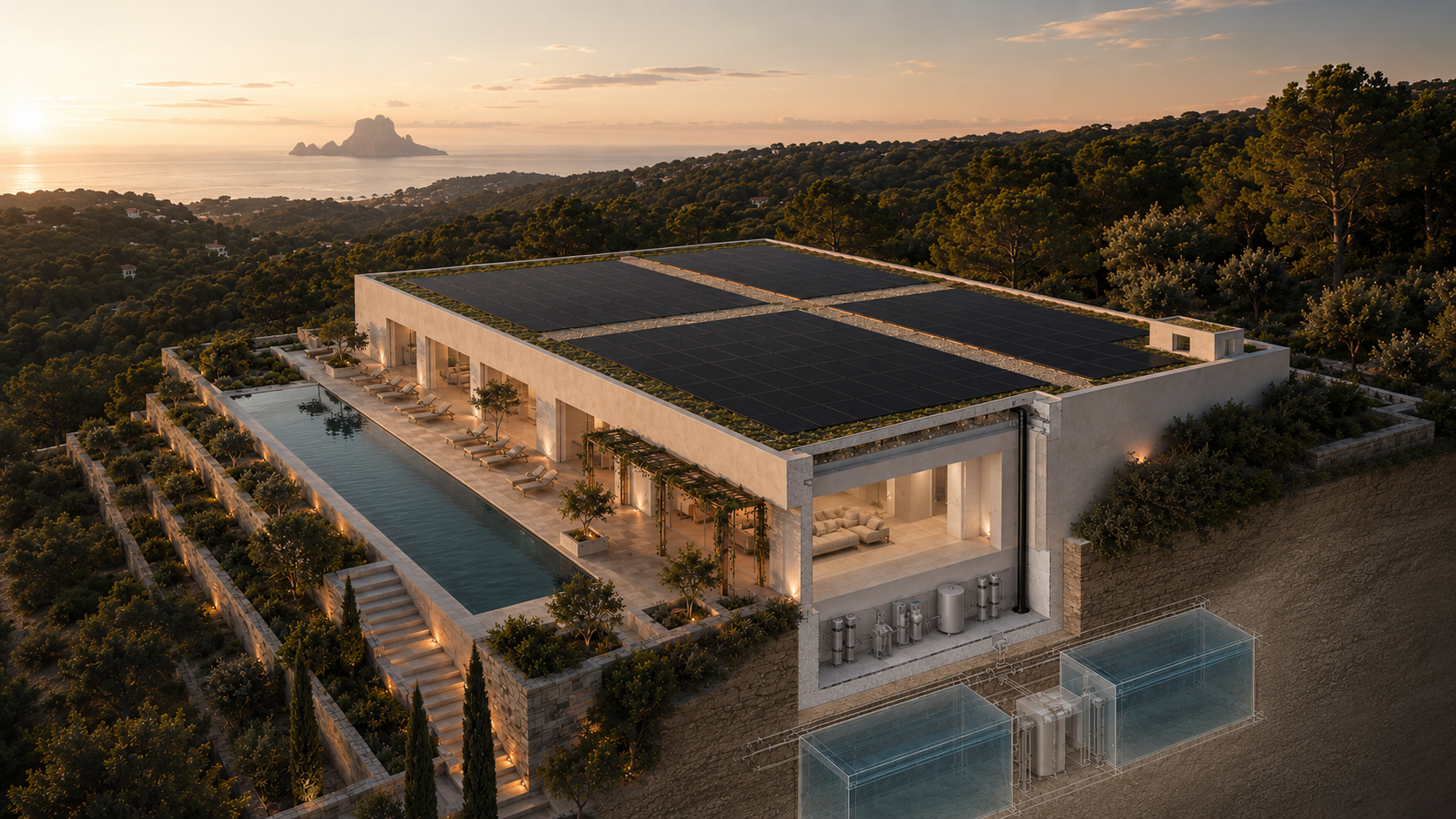
Stand on any ridge in rural Ibiza at the end of a dry August and the problem announces itself in silence. The land is the colour of bone. The cisterns are low. Somewhere below, a tanker is grinding up a track to deliver water to a house that cost more than the truck will earn in a decade. And above that house, catching the last of the light, sits a roof that has spent the entire year doing only half the job it could.
The high-end Mediterranean residential market has, over the past few years, quietly accepted the photovoltaic roof. The economics resolved; the aesthetics caught up; the owner who once refused panels now specifies them. That roof is treated, correctly, as infrastructure — it generates electricity, it offsets a bill, it adds certified value to the asset.
What that same roof does with rainfall, it treats as nothing at all. The water arrives on a tilted, glass-fronted, self-cleaning surface — precisely the geometry a hydraulic engineer would specify for catchment — sheets to the eave, and disappears into the drain. One output is infrastructure. The identical surface, producing a second output, is runoff. The difference is not physics. It is classification.
IThe arithmetic of one roof
The numbers are not marginal, which is what makes the paradox worth naming. A typical estate of the kind this addresses carries on the order of four hundred square metres of usable roof. Across an average Ibiza year that surface receives roughly four hundred litres of rainfall for every square metre it holds against the sky.
Multiply the surface by the rainfall and the roof receives, every year, more clean atmospheric water than the people living beneath it consume. Not a fraction of their demand — more than the whole of it, with surplus left for the garden and the dry months. The resource is delivered free, onto a structure the owner already paid an architect to design, and in the present building stock almost none of it is kept.
The roof produces more potable water than the people under it consume. It always did. The venture is the path between the two.
IIWhy the moment is now
If the surface has always behaved this way, the fair question is why it matters now rather than a decade ago. The answer is that three pressures have converged on the Southern European household inside the same narrow window, and each of them raises the value of being self-sufficient.
The first is the cost of water itself. Europe's environment agency does not expect Mediterranean water stress to ease before the end of the decade; Spain sits among the territories rated at the highest tier of climate risk on a business-as-usual path. Municipal supply is partly desalinated, increasingly rationed, unevenly available across rural geographies. Private boreholes salinise. Trucked delivery to a rural estate has become a normal annual cost line, often in five figures.
The second is the cost of electricity, which has risen materially across the past decade and is now structurally pre-loaded for the next. The new industrial demand of artificial-intelligence and data-centre infrastructure is forecast to push European electricity consumption up sharply by 2030 — a draw that competes directly with the residential grid. The household utility bill is no longer a background number. For the owner of a high-value property it has become a measurable component of asset economics.
The third is contamination, which compounds scarcity. Mediterranean rainfall now carries atmospheric dust, agricultural drift, and pollutants no traditional cistern was engineered to filter. Even where water is physically present, certified potable supply is not. Against that backdrop, a roof that can produce its own certified drinking water stops being a luxury and starts being a form of insurance.
IIIWhat was actually missing
The engineering was never the obstacle. The photovoltaic surface is already the catchment; the downstream chain that turns rainfall into water compliant with the European drinking-water standard is built from components a competent installer can source today. What has been missing is the path between the two treated as infrastructure rather than runoff — and, beyond the hardware, a financial layer that lets a household which cannot write a six-figure cheque finance the system against the utility cost it already pays.
That is the work. Not the invention of a water plant, but the closing of a loop that the building was always capable of completing. The principle is explored further across Architecture, The Roof, and the H₂O note.
IVThe discipline the surface restores
There is a final reason the high-end market resisted, and it had nothing to do with economics. For twenty years the choice an owner faced was discipline or solar. Retrofit panels strapped onto a pitched terracotta roof put two architectural registers in open conflict, and the luxury market — the language of the most disciplined contemporary minimalist architecture, quiet materials and considered proportion — refused the compromise. The owner kept the elevation pristine and forwent the system.
The flat photovoltaic roof resolves both questions in a single move. The array is the roof; the roof is the catchment. One plane, one material, no protrusions, the architect's line preserved at the horizon. Aesthetic restraint and full output, finally aligned rather than traded against each other. The roof stops being a single-purpose surface and becomes what it could always have been: the building's quiet, dual, productive fifth elevation.
Same surface. Two outputs. That is the whole of it.